
Canadian Army jumpmasters and tactical leaders recently participated in a high-intensity, multinational airborne training exercise hosted by the U.S. Army’s XVIII Airborne Corps at Fort Bragg, North Carolina. Held from April 7 to 10, 2025, the joint operation focused on enhancing interoperability between allied forces, sharpening readiness, and building trust through shared airborne and logistics training.
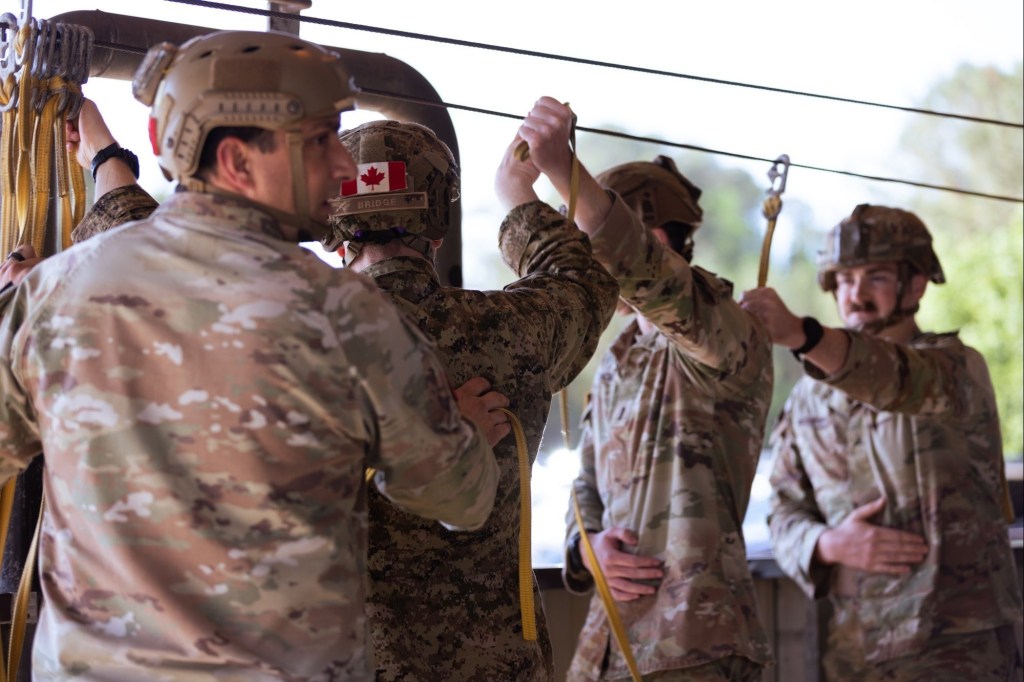
U.S. Army 1st Sgt. Bradley A. Spielman, 20th Engineer Brigade First Sgt., XVIII Airborne Corps, practices airborne operations with Canadian jump master and paratroopers from the XVIII Airborne Corps at Green Ramp on Fort Bragg, N.C., April 8, 2025. (U.S. Army photo by Spc. PS Bailey Whilden)
The week-long engagement provided the Canadian Armed Forces with valuable exposure to U.S. airborne doctrine, including how the Corps force-generates its Immediate Response Force, conducts contested logistics, repairs critical infrastructure like airfields, and delivers heavy equipment by air.
“Today was about teaching junior paratroopers how our allied forces work, building readiness and showing how different customs and courtesies work — both in and outside of the aircraft,” said 1st Lt. Shayna Chapman of the 1-505th Parachute Infantry Regiment, 82nd Airborne Division.
Beyond tactics and procedures, cultural exchange played a prominent role. U.S. paratroopers were energized by the unique morale-building traditions Canadian jumpmasters brought to the aircraft — from spirited cheering to rhythmic stomping just before jumping.
“They get pumped up — it’s just a difference in excitement levels that adds to the camaraderie,” Chapman added. “The United States never fights alone. Building these relationships ensures that when our paratroopers show up to the fight, the allied soldier next to them has their back.”
Canadian participants also worked closely with the U.S. Army Advanced Airborne School, gaining critical insights into drop zone planning, validation processes, and load rigging techniques. These shared lessons are vital as NATO allies modernize tactics and equipment to meet evolving battlefield demands.
“We spent time with the Canadians discussing how we execute airborne missions, rig our loads, and handle daily operations,” said Chief Warrant Officer 2 Chelsey Ashley of the 647th Quartermaster Company. “Seeing how they do things — what’s different or similar — brings trust and strengthens our bond.”
Ashley’s team demonstrated a diverse array of capabilities, from free-fall and MC-6 parachute operations to complex rough terrain jumps. A highlight of the week was the aerial delivery of the Avenger Air Defense System, which allowed Canadian observers to witness the scale and precision of U.S. logistics in action.
“Modernization is key — everything’s changing, and putting our brains together to tackle challenges like new parachutes and mission execution is incredibly important,” Ashley noted. “These exercises not only build trust but also allow us to act decisively and cohesively in dynamic environments.”
As global security threats become increasingly complex, joint operations like this serve as a cornerstone for operational success. For the Canadian Armed Forces, collaborating with allies like the United States ensures they remain agile, capable, and always ready to respond — together.
 Canada Defence Journal