
In a significant stride for China’s increasingly assertive space program, a crewed spacecraft carrying three astronauts successfully docked with the Tiangong space station today, marking the latest step in the country’s long-term vision of putting humans on the moon and, eventually, Mars.
The Shenzhou 20 mission launched precisely on schedule at 5:17 p.m. local time (0917 GMT) from the Jiuquan Satellite Launch Center, located on the edge of the Gobi Desert in northwestern China. Carried into orbit by the Long March 2F rocket—a mainstay of China’s crewed missions—the spacecraft reached Tiangong approximately 6.5 hours later.
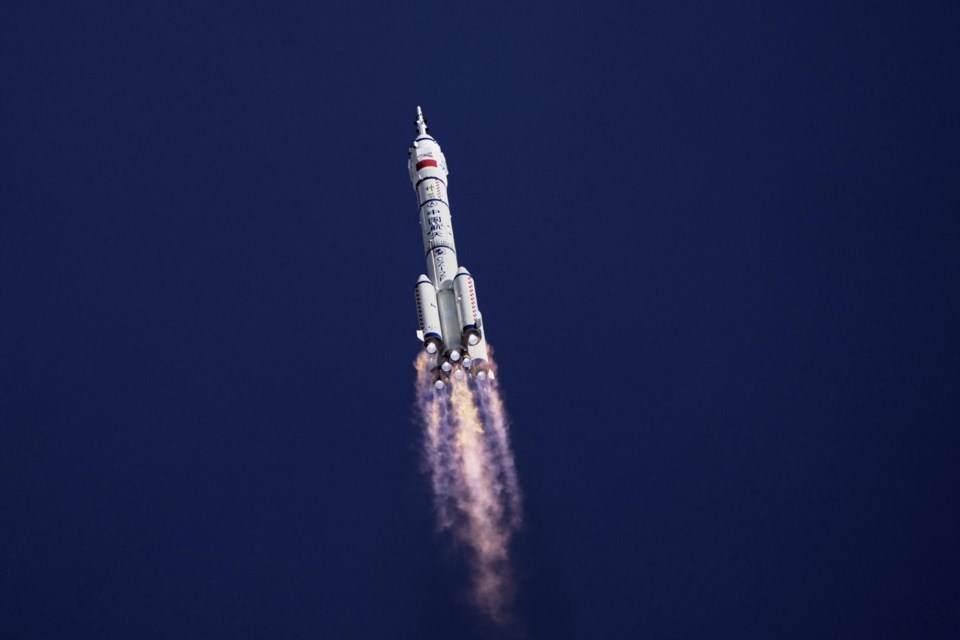
China’s Long March 2F rocket, carrying three astronauts for the Shenzhou 20 manned space mission, heads for a space station, at the Jiuquan Satellite Launch Center in Jiuquan, northwestern China, Thursday, April 24, 2025. (AP Photo/Andy Wong)
A Rotational Milestone with an Eye on the Moon
The mission represents the sixth crewed rotation to the Tiangong, or “Heavenly Palace,” since its assembly was completed in October 2022. Tiangong now serves as the centerpiece of China’s independent human spaceflight capabilities, particularly after its exclusion from the U.S.-led International Space Station (ISS) consortium over national security concerns.
Commanded by space veteran Chen Dong, making his third flight, the crew also includes Chen Zhongrui, a fighter pilot, and Wang Jie, an engineer—both of whom are flying for the first time. The all-male team will relieve the current crew of three astronauts who were launched in October last year and are scheduled to return to Earth on April 29, after a brief overlap.
Expanding Space Capabilities, and Influence
The Tiangong station—consisting of three pressurized modules—is capable of housing six astronauts during crew changeovers. Over the next six months, the Shenzhou 20 crew will conduct medical and technology experiments, perform maintenance operations, and install new equipment during planned spacewalks.
One feature drawing international attention is the addition of robotic arms to Tiangong, raising concerns over their potential dual-use capabilities in a conflict scenario. Analysts have noted that such technology could, in theory, be used to manipulate or disable satellites, adding a new dimension to the already evolving discussion on space-based security.
Despite this, China maintains that its space program is focused on peaceful development. However, its close ties to the People’s Liberation Army—which directly oversees the China Manned Space Agency—continue to fuel strategic scrutiny from other spacefaring nations.
Toward 2030: Lunar Landing and Beyond
Since becoming only the third country to send a human into space in 2003, China has rapidly scaled its space infrastructure. With successful landings on Mars and the far side of the Moon already under its belt, the next frontier is clear: a crewed lunar mission before 2030, with preparations for deep-space exploration on the horizon.
As geopolitical competition extends beyond Earth’s surface, the successful launch and docking of Shenzhou 20 reaffirms China’s growing role as a space power—one that is increasingly shaping the rules and norms of tomorrow’s orbital operations.
 Canada Defence Journal