
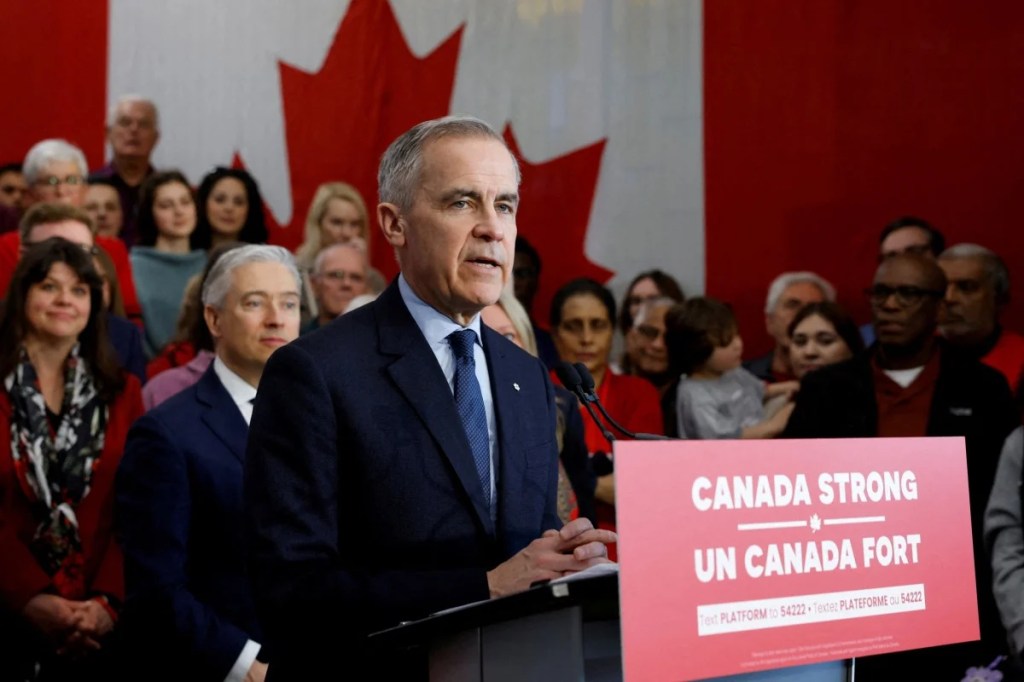
Canada’s Prime Minister Mark Carney announces the release of his party’s platform during his Liberal Party election campaign tour, at Durham College in Whitby, Ontario, on Saturday. Photo: Reuters
In a significant move that could reshape Canada’s defence posture for the next decade, Liberal Leader Mark Carney unveiled a costed election platform in Whitby, Ontario, on Saturday, pledging an $18 billion increase to existing defence spending by 2030. Carney, who is widely regarded as a fiscally sophisticated leader with international economic credentials, also left the door open for additional increases, stating, “It is possible we’ll need to do more.”
This proposal comes at a time of heightened global uncertainty, as traditional alliances are being tested and economic nationalism takes centre stage. With the United States retrenching under a second Trump administration, Canada’s long-standing reliance on its southern neighbour for both economic and defence assurance is now under scrutiny.
A Deficit-Fuelled Doctrine
Carney’s plan to ramp up military and strategic investments is part of a broader fiscal agenda that includes deeper federal deficits, tax relief, and infrastructure renewal. The projected deficit for the current fiscal year stands at C$62.3 billion, with C$129.2 billion in net new spending planned over four years. Despite this aggressive fiscal stance, Carney’s team argues that Canada’s debt-to-GDP ratio remains among the most sustainable in the G7.
While some critics may see this as reckless, the platform reframes the deficit as a tool of resilience. As Carney said during his announcement, “There should be no libertarians in a crisis.” In other words, strong state intervention—particularly in defence and economic diversification—is now framed as both necessary and pragmatic.
Defence in the Spotlight
The proposed $18 billion increase in defence spending signals a departure from the Trudeau-era incrementalism and suggests a pivot toward more robust capabilities. Although full details are yet to emerge, the platform implies funding would be distributed across:
- Modernizing Canada’s NORAD commitments, especially amid increasing Arctic tension.
- Expanding cyber defence infrastructure to address asymmetric threats.
- Enhancing recruitment and retention in the Canadian Armed Forces (CAF), potentially with increased wages, benefits, and support systems.
- Procurement modernization, including timelines for naval and air fleet renewals.
It is worth noting that Carney’s platform also emphasizes technology and AI-driven productivity. This could spill over into the defence sector through automation, advanced surveillance capabilities, and predictive logistics systems.
Balancing Ambition with Accountability
In a notable structural shift, Carney plans to split the federal budget into capital and operating expenditures, a model used in Quebec and several European jurisdictions. The operating budget—day-to-day expenses—would be balanced by 2028, while capital spending, such as defence procurements, would remain more flexible.
The platform anticipates a 2% cap on operating budget growth, a sharp reduction from the current 9%, suggesting a longer-term discipline plan even as initial spending expands.
Conservative Leader Pierre Poilievre has yet to unveil his costed platform but has committed to a “dollar-for-dollar” fiscal rule—saving one dollar for every new dollar spent. This sets the stage for a contrasting ideological battle over how best to navigate Canada’s economic and strategic future.
Strategic Autonomy in a Shifting World
Carney’s emphasis on trade diversification and transition bonds for cleaner industries further signals a push for strategic autonomy—both economically and militarily. With $20 billion in revenue expected from retaliatory tariffs against the US, much of which is slated for redistribution to Canadian workers and businesses, the Liberals are taking an assertive stance in reshaping Canada’s role in a multipolar world.
In military terms, this vision mirrors moves by Germany and other NATO members, who are also expanding their defence budgets amid declining transatlantic certainty.
Conclusion: A New Defence Consensus?
Whether Mark Carney’s platform is a bold reset or a fiscal overreach will depend on both electoral outcomes and economic conditions in the coming years. What is clear, however, is that defence spending is no longer a footnote in Canadian politics—it is rapidly becoming a pillar of national resilience, economic renewal, and global positioning.
Should the Liberals prevail on April 28, expect a Canada that leans further into its sovereignty—on the battlefield, at the negotiating table, and in the balance sheets.
 Canada Defence Journal