
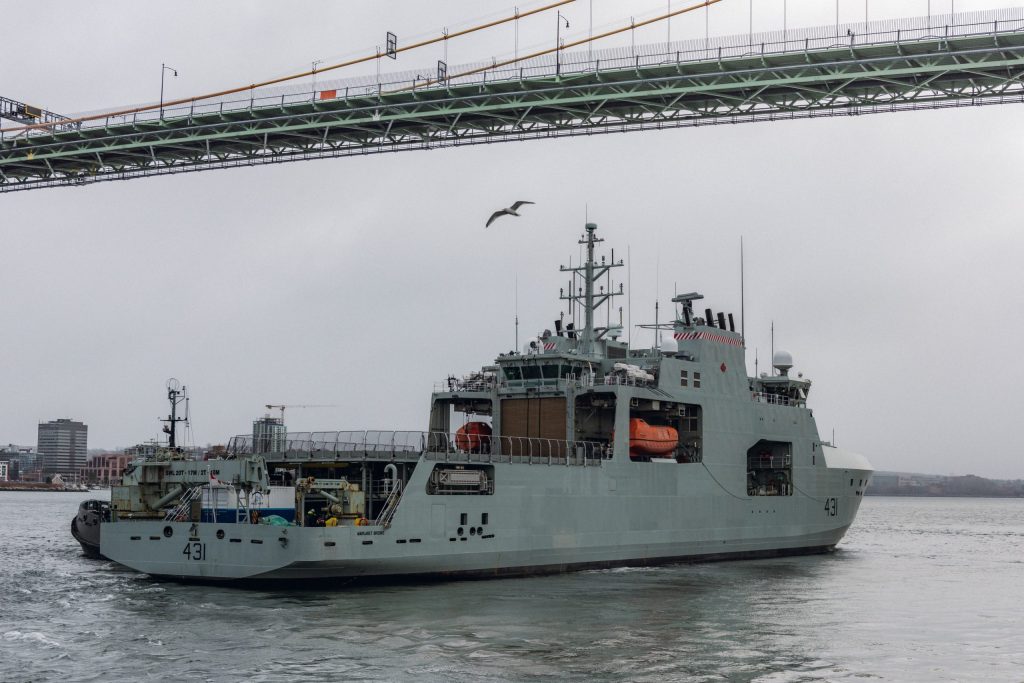
The HMCS Margaret Brooke sets sail on a 4-month mission, OpProjection 2025. Image source: Royal Canadian Navy
After a four-day official visit to Peru, the Royal Canadian Navy’s Arctic and Offshore Patrol Ship (AOPS), HMCS Margaret Brooke, departed Callao Naval Base alongside the Peruvian Navy’s BAP Bolognesi (FM-57), a Lupo-class frigate, and the BAP Angamos (SS-31), a 209/1200-class submarine. The coordinated maneuvers marked a key milestone in bilateral naval cooperation, with joint exercises focused on improving interoperability and maritime coordination between the two navies.
This engagement formed part of Operation PROJECTION, an ongoing Canadian Armed Forces initiative designed to project Canada’s naval presence globally, strengthen relationships with partner nations, and support scientific and humanitarian efforts. The deployment of Margaret Brooke is notable for being the vessel’s first mission to the Antarctic region, signaling an evolution in Canada’s operational reach in polar and sub-polar theatres.
Strengthening Regional Ties
As part of its broader circumnavigation of South America, Margaret Brooke docked at the Buenos Aires Naval Station in Argentina, where it conducted bilateral exercises with the Argentine Navy’s ARA Almirante Brown (D-10). These collaborative efforts underscore Canada’s commitment to regional maritime security and the development of cooperative frameworks with Latin American naval forces.
Further south, the vessel made a significant visit to Chile’s Presidente Frei Antarctic Base, operated by the Chilean Air Force on King George Island (25 de Mayo Island). Here, the ship supported scientific personnel, providing logistical assistance to Canadian and allied researchers studying the Antarctic environment—a role central to the mission profile of the Harry DeWolf-class patrol vessels.
Designed for the Polar Frontier
Commissioned in 2021, HMCS Margaret Brooke is part of Canada’s Harry DeWolf-class, purpose-built for Arctic operations and extreme climate readiness. The ship measures 103.6 metres in length, displaces over 6,000 tonnes, and features a flight deck capable of supporting helicopter and UAV operations. With a complement of approximately 65 personnel, the vessel is designed for versatility—whether supporting sovereignty patrols, scientific expeditions, or humanitarian missions in remote regions.
Quiet Strength and Seamless Logistics
In addition to its high-profile engagements, the patrol ship made a logistical stop in Valparaíso, Chile, where the crew conducted resupply operations and took part in routine maintenance. While no public engagements were scheduled in Chile, the stopover played a crucial part in sustaining the long-range deployment, which highlights Canada’s growing logistical and operational capabilities in the global maritime domain.
As HMCS Margaret Brooke concludes its extended South American journey, the Royal Canadian Navy reaffirms its role not only as a defender of Canadian waters but also as a proactive participant in regional security and scientific collaboration. The deployment sends a clear message: Canada’s naval presence is increasingly agile, capable, and globally engaged.
 Canada Defence Journal